Mornings When Birds Die

I count to ten in my head, and the baby bird shudders a weak breath. I count again, this time making it to fifteen. Beats of silence skip across time like stones on a glass lake. It’s plumed chest puffs and it rasps out another breath. The stones clatter against the lake. Thirty seconds. The bird remains still. One minute. “I think it’s dead,” my sister whispers. I lean into the neon orange Nike shoebox my mother had placed the bird in, desperately searching for signs of life. Its eyelids droop into waning crescents, and crumbs of food cling to its hanging beak. One minute and thirty seconds. The clanging of the stones is incessant. My head begins to hurt. “Well, at least we tried,” my mother sighs, clicking her tongue. Two minutes. “Are you okay? You’re turning purple,” my sister snickers. I wheeze out the air trapped in my chest. The bird is dead; the lake fragments. “I knew it wasn’t going to survive the night,” my mother says. My heart cinches, and I look away from the shoebox turned graveyard.
“You can’t seriously be crying. It’s just a bird,” my sister snorts. I reach up to touch the warm, quiet tears that had sprung in my eyes. My mother shifts next to me and rubs my shoulders. The bird’s limp body flops over, and I gulp down a sob.
“What’s going on here?” my dad enters the kitchen, stage right. He siddles up next to my mom, peering into the box. “Ahh...” he mumbles. He reaches into the box and softly closes the bird’s half-opened eyes. Tears continue streaming down my face. My dad turns to me and I watch his brows stitch into a furrow. “Por qué estas llorando?” Before I have the chance to answer, my mother chimes, “Your daughter feels things too deeply.” My dad laughs, and hugs me the way he always did ever since I turned 13. Awkwardly and never quite close enough. “If you think watching un pajarito die is hard, try watching your own mother die,” he chuckles. My mother slaps him on the arm, “You’re not helping.”
“We’re going to be late for school,” my sister groans, and my family scatters like petals in the wind. I glance back at the bird’s still corpse, and let the lake swallow me whole. Some days, I wonder if by some spectacular sliver of misfortune, I wasn’t let into some giant secret about how to properly be human.
***
“You know what’s the weirdest thing about not being sad anymore?” I say. “What?” Aubrey asks, curling her fingers around mine. “When sad things do happen, I think I feel the perfect amount of sadness. Like, the amount of sad that I imagine normal people must feel.”
“I think the Prozac is working,” she snickers. I nudge her shoulder with mine. A couple seconds of silence drift between us. “So, are you going to tell me what happened?” she says. “You’re going to think that I’m a crybaby,” I say, sighing reluctantly. “I already do. Might as well just tell me.”
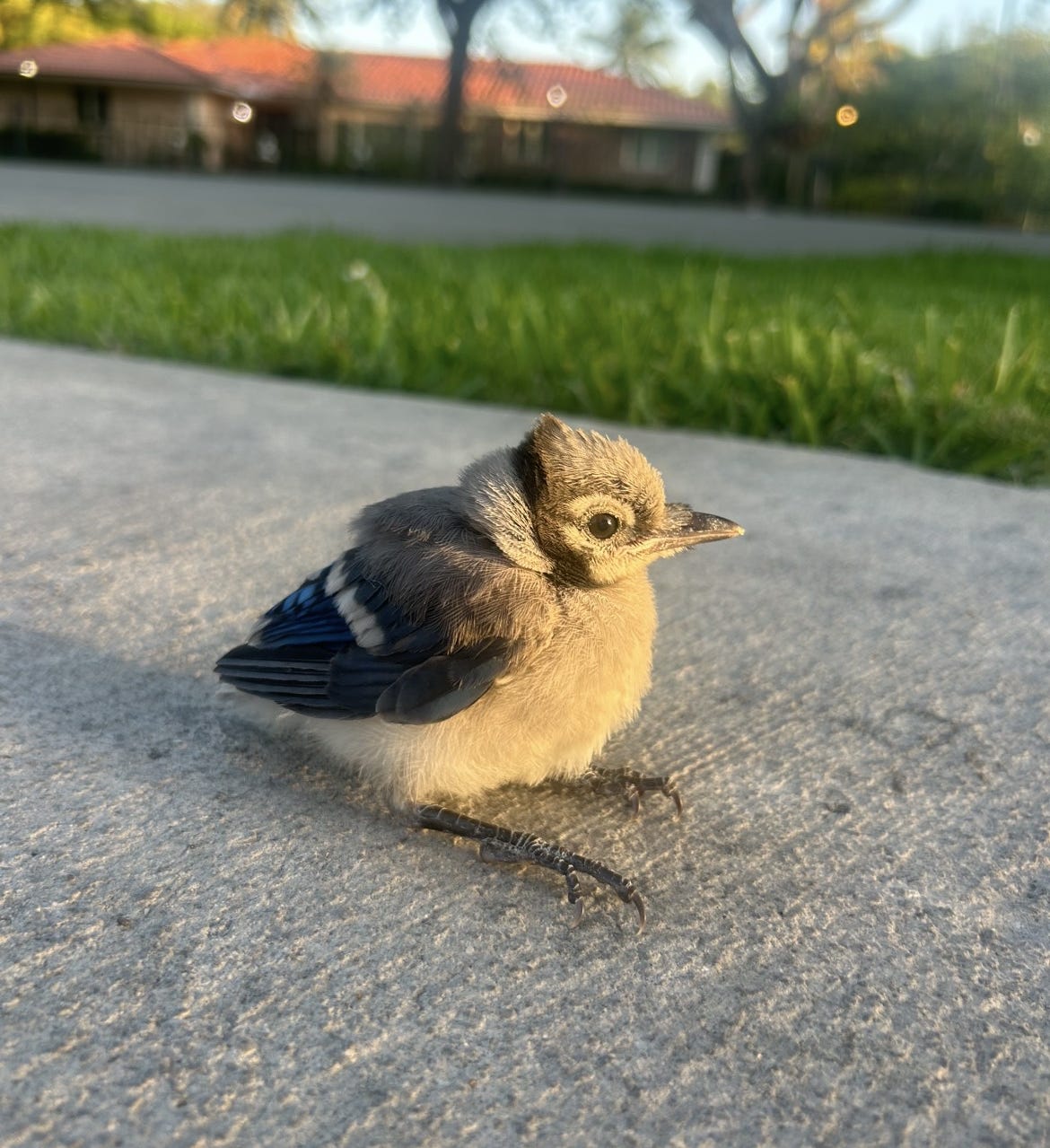
I laugh, peering toward the throng of people sifting in and out of the cafeteria from the bench we were sitting at. “My mom saved this injured baby blue jay yesterday while walking our dog. We all tried to nurse it back to health, but it died this morning. I watched it die.” Aubrey nodded slowly. “What did that feel like?”
“Really weird. I tried pinpointing the exact moment it happened, but I couldn’t. One second it was there, and then it was gone.”
“I hope my death is that boring,” she says, shaking her head. I smile, focusing on the cracks of skin between the joints of her fingers. Her eczema was worsening, and I made a mental note to buy her another pack of band-aids.
“Y’know, I’ve always thought it was better to feel too much than to feel too little,” Aubrey says. “You sound like my therapist,” I groan. “You should just pay me instead,” she says, a half smirk tugging at her lips. I laugh and punch her lightly on the shoulder. We settle into a comfortable silence, and I count to thirty-three in my head before she breaks the stillness.
“Do you ever worry that it’ll come back?” Aubrey asks.
If it were anyone else, the frankness the question would have startled me, but I answer without so much as a hitch. “I guess, yeah. I think a part of me even misses it sometimes.”
“Why?”
“In a way, it made me feel more alive than I’d ever been. It’s like the grief opened a third eye that magnified every detail around me, because clinging to the small stuff made the big things bearable. Now that eye is sewn closed, and I feel like an out-of-focus camera.”
“This is what happens when you don’t wear your glasses. Blind ass,” she tuts. “That’s not the point,” I say.
“Yeah, yeah. I know,” she scans my expression for amusement and when she fails to find it, she continues. “You describe your pain like its an appendix. It served some function back when we were monkeys that still chewed on leaves to survive, but some people are better off living without it, like when it gets infected. Better to take that shit out before it explodes and takes you with it. Besides, you’d look pretty fucking stupid with three eyes,” she says, flicking the center of my forehead with a gentleness only she could achieve. We laugh, and I search for the beauty in the sound.
“I don’t know how you manage to understand me more than I understand myself,” I say.
“It’s a pleasure deciphering someone as strange as you,” she says, winking.
“You’re making me sound like a Rubik’s cube.”
“Sounds about right. Mostly square and kind of a pain to solve but when you do there’s no feeling like it.”
The lunch bell rings and we both stand up to leave, but leave our hands linked. Aubrey is the kind of friend others tell me they wish they had. At night, I’ll pray to a God I don’t believe in and wish an Aubrey for them too.
“What would I do without you?” I say, shaking my head.
Her lips curve into a smile, and she squeezes my hand. “I ask myself the same thing.”
***
I’m in the middle of searching up the odds of a baby blue jay surviving a broken leg when I bump into a weathered sign. It reads “SOK SHP.” I stare at the sign disoriented for a couple of minutes before realizing that it’s meant to read smoke shop. I hear Murray slinking up behind me before I even turn around.
“You know what they call your generation nowadays,” he rasps out with a voice worn down from decades of smoking. “What would that be?” I ask, whipping around. He flashes a toothy, lopsided grin and crosses his arm. “The heads-down generation, because you all have your heads buried in those damn phones.” I sigh, tucking my phone into my pocket. “For the record, I was attending to important business,” I note, and he snorts. “I’m sure. It’s that guy, isn’t it?” he asks in a tone that could well be mocking or apathetic curiosity. I pick the curiosity. “God no. Just the thought of talking to him makes me want to throw up,” I say, feigning a gag. He rolls his eyes and saunters over to the edge of the sidewalk.
“Back in my day, when you wanted to talk to someone, you just did,” he muttered, before plopping down to sit on the edge. “Well back in my day, when you wanted to talk to somebody, you just stared at them hard enough hoping that they’ll notice you before your head pops off,” I say, sitting down next to him. “I reckon that hasn’t worked out too well for you considering you’ve still got a head,” he says. I shrug. “At least I’ll die trying.”
“Some trying that is,” he snorts, taking out a pack of Marlboros. “I thought you quit,” I say. “Yeah, well I got the divorce finalized and a man has to celebrate somehow.” He lights the cigarette and pulls out another one. He juts it in my direction. “You want one?”
“Thanks, but I’ll pass,” I wave the cigarette away. “Good. Don’t ever start or you’ll end up like me,” he says.
“Divorced?” I say.
“No. A loser,” he chuckles.
“Does it hurt?” I ask. “My bank account? Like a bitch. Those lawyers sucked me dry only for Marie to win the kids and the house. Got the damn dog as a consolation prize. It’s the small things, am I right?” He takes a drag. I watch his yellowed teeth peek out from an open crevice in his lips.
“I meant the divorce.”
He sucks in a puckered breath. “Not really. It was a long time coming.” He takes another drag and leans back. I stare out into the parking lot, watching the light reflect off a Toyota a couple feet away.
“Do you think that makes me a dirtbag?”
“What?”
“It's just…I know I made mistakes. But twenty years down the drain and I can hardly bring myself to feel anything at all. Now I’m just some guy who had it good sitting next to a kid in front of a smoke shop.” Murray throws the cigarette on the ground and stamps on the butt. A spark flies out as he does so.
“You know what the worst part is?” He says, burying his face in his hands.
“That you tried?” I say.
He looks up from his hands, his eyes bloodshot and covered with a wet sheen. This is the closest he will ever get to crying, because men like Murray don’t cry. Bad things will happen to them, and they’ll spend the rest of their lives stuffing it into a bottle and chucking it to the sea. Moments like these are when the bottle ends up on the shore.
“I don’t even know why I’m crying,” he says, despite not really crying. He wipes at his face with the sleeve of his jacket.
“Today I watched a bird die and I cried,” I say. “I might not know what it’s like to end a twenty year marriage, but I know what it’s like to watch something end.”
Murray takes in a shaky breath, and the noise reminds me of the bird.
“Can I ask you a question?” He asks. I nod wordlessly.
“Do you think that before people are born, their souls are told about all the crap they’re gonna feel? Do we get shown our entire miserable lives and then decide for ourselves whether or not we want to do the whole ordeal?”
I pause for a moment, contemplating this. “I don’t think half of the people on this planet would choose to live the lives they’re currently living if it were up to them.” Murray picks up a pebble laying on the sidewalk and attempts to skip the pebble on the cement. The pebble hops twice before finding a home beneath one of the front tires of the Toyota.
“Beats doing nothing for all of eternity, though,” I add.
“I’m sure they’re doing just dandy sipping their cosmic coffee while we cry over stupid shit,” he says, an expression betraying fatigue momentarily flashing across his face.
“Maybe that’s what life is. Crying over women and birds.”
He laughs and stares towards the ebbing Sun. “Sometimes I have the sneaking suspicion that you’re an eighty-year old wearing the skinsuit of a teenager.”
“You’ve found me out,” I say, and he grins again. I take out my phone out to check the time. “Gotta finish walking home now. My mom might think that you’ve actually kidnapped me this time around.”
I stand up to leave, but Murray reaches into his pocket and hands me another cigarette. “For the next time you watch a bird die. Or get divorced.”
I take the cigarette and pocket it. As I walk away, I open my phone to finish my investigation. A broken leg is more often than not a death sentence.
***
While I walk home, I wonder about how my father must’ve felt watching his mother die. How he must’ve felt, sitting in a cold, sterile room amidst the whirring and beeping of machines; their noises a frantic cacophony offering the duplicitous perception that her life could still be saved. I wonder how he must’ve felt as he watched the cancer confiscate a body that had once given life to his. I wonder if he felt scared that the monster was in him too, in his children, and in the children that dance in dreams, ready to obliterate, decimate, destroy all that had once belonged to him, all that he had worked for.
The drops of dew that spill from the leaves, stippling the sidewalk.
Prior to her death, his mother had been on the road to recovery for months. She was on the verge of being declared free when it came back. Within a week of its return, she was dead. My father had described it as vicious, as though it was a tiger that had suddenly and unexpectedly lunged at her and ripped her to shreds, tearing tissue from bone, sinew from flesh, rather than an entity that had simply been lurking all along, biding its time.
The sky, doused in an amber glow, golden light shimmering through murky clouds.
I wonder how my father felt when he watched the light leave her eyes. I wonder if he was able to locate the precious moment where one lingers not in death nor life, but in the nebula between. It took a week, it took a second. I wonder if I watched another bird die, would I be able to find it? How many birds must die before I find it?
The worms that crawl around the freshly soaked soil, food for baby birds.
Aubrey told me that when her father broke the news to her, she felt nothing. A resounding emptiness, an old clay jar stuffed with nothing but dust and memories. How many mothers must die before we realize there is nothing we can do about mothers dying?
The buzzing of the cicadas, hidden in sodden bark.
Some days I worry it will come back. With the same viciousness as my grandmother’s cancer; at first nothing, and then all at once. As I cry for baby birds and sick mothers, I worry the tears will never end, the way they never did before, and I’ll drown in the currents of indecision I fought so hard to get out of.
The stray bush that loiters around the driveway, refusing to die.
I wonder if my father felt the same impotence watching his mother that I did watching the bird, that I do watching myself. I’ll heave helplessly against the hands of time and I’ll try not to think too hard about the end, because endings have always been hard for me.
The sharp, clean scent of a late evening shower, permeating the air.
I’ll always be a little more sad than you’d like me to be but I’m okay with that, and I’ll pray to a God I don’t believe in that you are too. I know you won’t judge, because that’s who you are, but I’ll feel the judgement anyways, because that’s who I am. In the meantime, I’ll rip the suture off my eye and squint real hard, trying my best to ignore the blood clouding my vision. I implore you to ignore this as well.
The breeze that pulls at my face, stirred by the flap of wings echoing into the ether.
I’ll think of Murray and the way his skin sags a little the way it does when the weight of the years, which is to say your choices, catch up to you. I’ll think of Aubrey and the way her hair looks when the wind’s fingers comb through it, a tributary of iridescent oil. I’ll think of my father and the way his eyes crinkle like gently folded napkins when he laughs; may the memory of his mother leave him then.
I spot my father standing by the front door, waving a hand as though to beckon me inside. I wave back, walking over to him while listening to the crackling of wet gravel, dirt, and hope beneath my feet.
“How was your day, mija?” he asks.
“Fue bien,” I say, giving him a gentle hug.
“Todavía piensas sobre el pájaro?”
I turn away, hoping he won’t feel the shame radiating off of me. “Yeah.”
He squeezes my shoulders gently, and looks towards the overcast sky.
“Algunas cosas siempre van a morir,” his stare deepens, and he opens his mouth as though to say more, but doesn’t.
I look towards my father and search his eyes, finding nothing but residue left from years of love and loss. I wonder briefly if anyone will ever grieve my death the way I did the bird’s. He turns back towards me, smiling, before opening the door.
***
Before the bird died, it let out a sonorous chirp, as though to expel its final wishes, its final drops of resolve. I’ll think of the noise, and how it reminds me of the way you look at me.
Unwavering and forgiving.
still one of the most beautiful short stories I’ve read. love you and your writing always